Nanobubble Technology for Industrial and Municipal Wastewater Treatment
NICO Nanobubble USA provides advanced nanobubble generation and gas transfer solutions for industrial wastewater treatment, municipal wastewater facilities, and water quality management. Our technology is engineered to help wastewater operators improve gas transfer efficiency, support biological treatment processes, optimize aeration, and evaluate opportunities for more efficient plant operations.
Conventional wastewater treatment systems often face challenges associated with oxygen transfer limitations, fluctuating organic loads, high aeration energy requirements, and increasingly stringent effluent quality targets. NICO Nanobubble Technology offers an alternative approach to gas delivery by generating extremely small gas bubbles that can enhance gas transfer into water when applied under suitable operating conditions.
Our application-specific systems are designed to integrate with existing wastewater treatment infrastructure, allowing facilities to evaluate performance improvements without necessarily undertaking major civil modifications or replacing their entire treatment process.
How Nanobubble Technology Supports Wastewater Treatment
Nanobubbles are extremely small gas bubbles, typically less than 200 nanometers in diameter in NICO's nanobubble applications. Their size and interfacial properties distinguish them from conventional macro- and microbubble systems and can influence how gases transfer and behave in water.
NICO's nanobubble generation systems are designed to improve the delivery of gases such as oxygen, ozone, and air, depending on the treatment application and system configuration.
Key characteristics include:
- Enhanced gas transfer: Supports the transfer of oxygen and other selected gases into wastewater, helping meet process-specific gas demand.
- Extended bubble persistence: Nanobubbles can remain dispersed in water longer than conventional larger bubbles, depending on water chemistry and operating conditions.
- High interfacial area: Small bubble size provides a large gas–liquid interfacial area relative to the gas volume, supporting gas transfer processes.
- Application-specific gas delivery: Systems can be configured for oxygenation, ozone-based treatment, or other suitable gas transfer applications.
- Retrofit compatibility: Nanobubble generators can be evaluated for integration into existing tanks, treatment basins, and side-stream circulation arrangements.
Actual performance depends on wastewater composition, temperature, pH, gas selection, hydraulic conditions, and the configuration of the existing treatment process.
Nanobubble Solutions for Industrial and Municipal Wastewater
NICO Nanobubble USA offers specialized platforms for different wastewater treatment requirements. Selecting the appropriate system depends on the wastewater source, treatment objectives, operating conditions, and existing infrastructure.
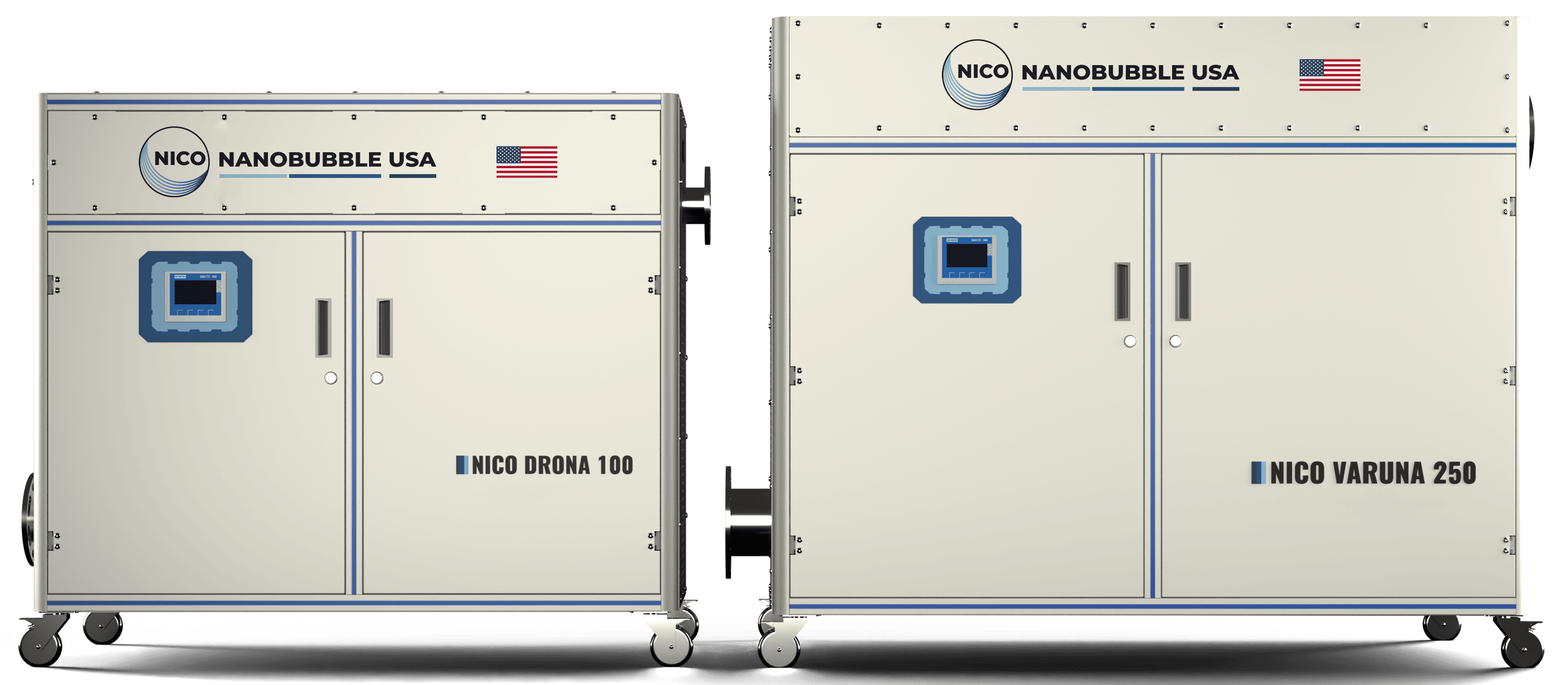
NICO DRONA: Industrial Wastewater Treatment
NICO DRONA is designed for industrial wastewater treatment applications, including facilities that require improved oxygen delivery, biological process support, or application-specific oxidation.
Industrial effluent characteristics can vary significantly across manufacturing sectors. High organic loads, complex wastewater composition, and variable production schedules can place additional demands on biological treatment and aeration systems.
NICO DRONA can be evaluated for integration into industrial wastewater treatment plants, aeration tanks, equalization basins, and suitable side-stream treatment systems. By improving oxygen transfer under appropriate operating conditions, the system can support aerobic microbial activity and the biodegradation of organic matter.
Depending on the wastewater characteristics and process configuration, nanobubble technology may also be assessed as part of an oxidation or pretreatment strategy for challenging industrial effluents.
Potential applications include:
- Textile manufacturing and dyeing wastewater
- Pharmaceutical and specialty chemical wastewater
- Chemical and petrochemical effluent
- Food and beverage processing wastewater
- Pulp and paper manufacturing wastewater
- Industrial water recovery and reuse systems
NICO DRONA is selected and configured according to flow rate, wastewater loading, oxygen demand, existing treatment processes, and required discharge or reuse targets. Reductions in BOD, COD, or other pollutants must be established through application-specific testing and performance monitoring.
NICO VARUNA: Municipal Wastewater Treatment and Drain Management
NICO VARUNA is designed for municipal wastewater treatment plants, sewage treatment facilities, sewer systems, and open-drain treatment applications.
Municipal wastewater systems can experience oxygen depletion, variable organic loading, odor generation, and operational constraints that affect treatment stability. Improving gas transfer can help support aerobic biological treatment and provide operators with additional options for managing wastewater quality.
NICO VARUNA can be evaluated for existing municipal wastewater treatment plants seeking to optimize oxygen delivery, improve treatment performance, or assess opportunities to upgrade their current processes. For drain and sewer applications, appropriately configured oxygen or ozone nanobubble systems may be considered according to the characteristics of the wastewater and the intended treatment outcome.
The platform can also be assessed for retrofit applications where facilities want to explore treatment improvements without relying exclusively on additional tanks or major civil expansion.
System design depends on wastewater flow, BOD and COD concentrations, dissolved oxygen requirements, hydraulic retention time, existing treatment technology, and applicable discharge or reuse criteria. Site-specific trials and water quality testing are recommended to verify performance.
Improve Wastewater Aeration and Gas Transfer Efficiency
Aeration is a major energy consumer in many biological wastewater treatment facilities. Conventional aeration equipment must deliver sufficient oxygen to support the biological processes responsible for breaking down biodegradable pollutants, while maintaining appropriate dissolved oxygen levels throughout the treatment system.
NICO Nanobubble Technology provides an alternative gas transfer approach that can be evaluated alongside existing aeration equipment and process controls.
Potential areas of improvement include:
- Oxygen transfer optimization: Improve oxygen delivery to support biological treatment requirements.
- Aeration energy management: Evaluate opportunities to reduce blower operation or supplemental aeration while maintaining treatment performance.
- Process stability: Support oxygen availability as wastewater loading and operating conditions change.
- Operational monitoring: Track dissolved oxygen, energy consumption, and effluent quality to assess the impact of nanobubble integration.
NICO DRONA supports industrial wastewater applications, while NICO VARUNA addresses municipal wastewater and sewage treatment requirements.
Aeration energy savings of 15–40% may be a target for evaluation in suitable applications, but should not be assumed for every facility. Actual savings depend on baseline aeration efficiency, oxygen demand, equipment configuration, process controls, and the results of a controlled performance assessment.
Support for Oxidation and Contaminant Removal
Nanobubble technology can also be evaluated for selected wastewater oxidation applications. Oxygen-based systems may support biological treatment, while ozone-based configurations can be assessed where additional oxidation is required.
Ozone reacts with susceptible compounds in water and, under appropriate conditions, can contribute to the formation of reactive species involved in contaminant transformation. These mechanisms may be relevant to wastewater containing selected organic compounds, color-causing substances, or other treatment-resistant constituents.
Potential applications include:
- Oxidation support for selected industrial effluents
- Treatment of color-bearing textile wastewater
- Pretreatment of wastewater containing complex organic compounds
- Supplemental treatment for selected water reuse applications
- Evaluation of odor management strategies
The effectiveness of oxidation depends on the target contaminants, ozone dose, water chemistry, contact conditions, and competing reactions. Nanobubble generation alone does not guarantee complete contaminant removal or establish a specific advanced oxidation process. Appropriate testing is required to determine whether an application meets its treatment objectives.
Environmental and Operational Considerations
NICO Nanobubble USA helps facilities evaluate how improved gas transfer can fit into their broader wastewater treatment and resource management strategies.
Chemical optimization: In suitable applications, improved gas transfer or ozone delivery may provide opportunities to optimize chemical use. Actual reductions depend on the existing treatment process and must be verified.
Energy management: Nanobubble integration can be assessed for its impact on blower demand, pumping requirements, and total system energy consumption.
Odor management: Maintaining appropriate oxygen conditions may help reduce the formation of odor-producing compounds associated with anaerobic conditions. Results depend on the wastewater characteristics and the underlying cause of the odor.
Water reuse: Nanobubble systems can be considered as one component of a broader treatment train intended to support water recovery and reuse. Reuse suitability depends on the complete treatment process and applicable water quality requirements.
Infrastructure upgrades: Retrofit configurations may allow facilities to assess treatment improvements using existing tanks and circulation systems, subject to hydraulic, mechanical, and process requirements. These benefits should be evaluated using site-specific operating data rather than assumed across all wastewater treatment applications.
Industrial Wastewater Treatment Applications
NICO DRONA can be evaluated across multiple industrial sectors where wastewater composition and treatment requirements vary.
Textile and dyeing: Support for oxygen transfer and biological treatment of wastewater containing dyes and organic loads.
Pharmaceutical and chemical manufacturing: Evaluation of oxygenation and selected oxidation processes for complex industrial wastewater.
Food and beverage processing: Support for biological treatment of wastewater with biodegradable organic loads.
Petrochemical and process industries: Application-specific gas transfer and treatment support based on wastewater composition and operating requirements.
Pulp and paper: Evaluation of oxygen delivery and biological process support for manufacturing wastewater.
Industrial water reuse: Potential integration into existing treatment trains where facilities are pursuing water recovery, reuse, and reduced freshwater demand.
The suitability of nanobubble technology varies by application. Pilot testing can help establish the appropriate system configuration, operating parameters, and measurable treatment outcomes.
Integration with Existing Wastewater Treatment Infrastructure
NICO Nanobubble Generators can be evaluated for integration into existing wastewater treatment plants, including suitable aeration basins, equalization tanks, treatment vessels, and side-stream circulation systems.
A retrofit assessment considers hydraulic capacity, pump requirements, available space, piping connections, gas supply, electrical infrastructure, and the operating characteristics of the existing treatment process.
The objective is to identify a practical integration strategy that supports the facility's treatment goals while accounting for installation requirements, ongoing maintenance, and operating costs.
Installation complexity and maintenance requirements vary with system configuration and site conditions. Performance should be verified after commissioning through appropriate operational monitoring and water quality analysis.
Explore Nanobubble Solutions for Your Wastewater Facility
NICO Nanobubble USA works with industrial and municipal wastewater operators to evaluate nanobubble-based gas transfer solutions for existing and new treatment applications.
Whether your facility is looking to optimize aeration, support biological treatment, assess an oxidation process, or explore improvements to an existing wastewater treatment plant, our team can help identify an application-specific approach.
Contact NICO Nanobubble USA to discuss your wastewater treatment requirements and evaluate a suitable nanobubble generation system.