Nanobubble-Driven Process Optimization of a 7 MLD
STP for Capacity Enhancement and Energy Reduction
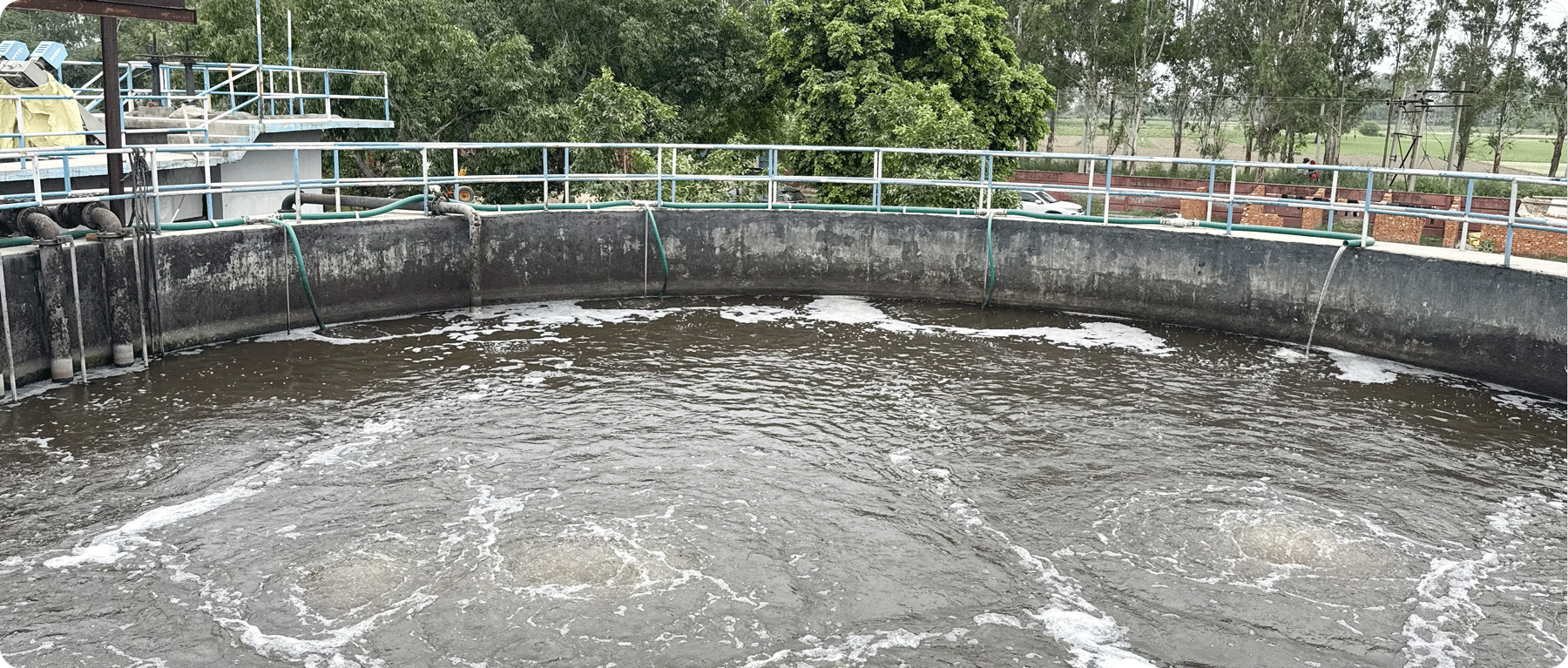
Aeration remains the most energy-intensive component of municipal wastewater treatment plants and can significantly influence both operational efficiency and plant capacity. Conventional aeration systems often experience limitations in oxygen-transfer efficiency, resulting in higher energy consumption and restricted biological performance.
This case study presents the full-scale implementation of NICO Nanobubble Technology in a 7 MLD MBBR-based Sewage Treatment Plant in Haryana, India. The objective was to enhance oxygen-transfer efficiency, reduce aeration energy demand, and unlock additional treatment capacity without civil infrastructure expansion.
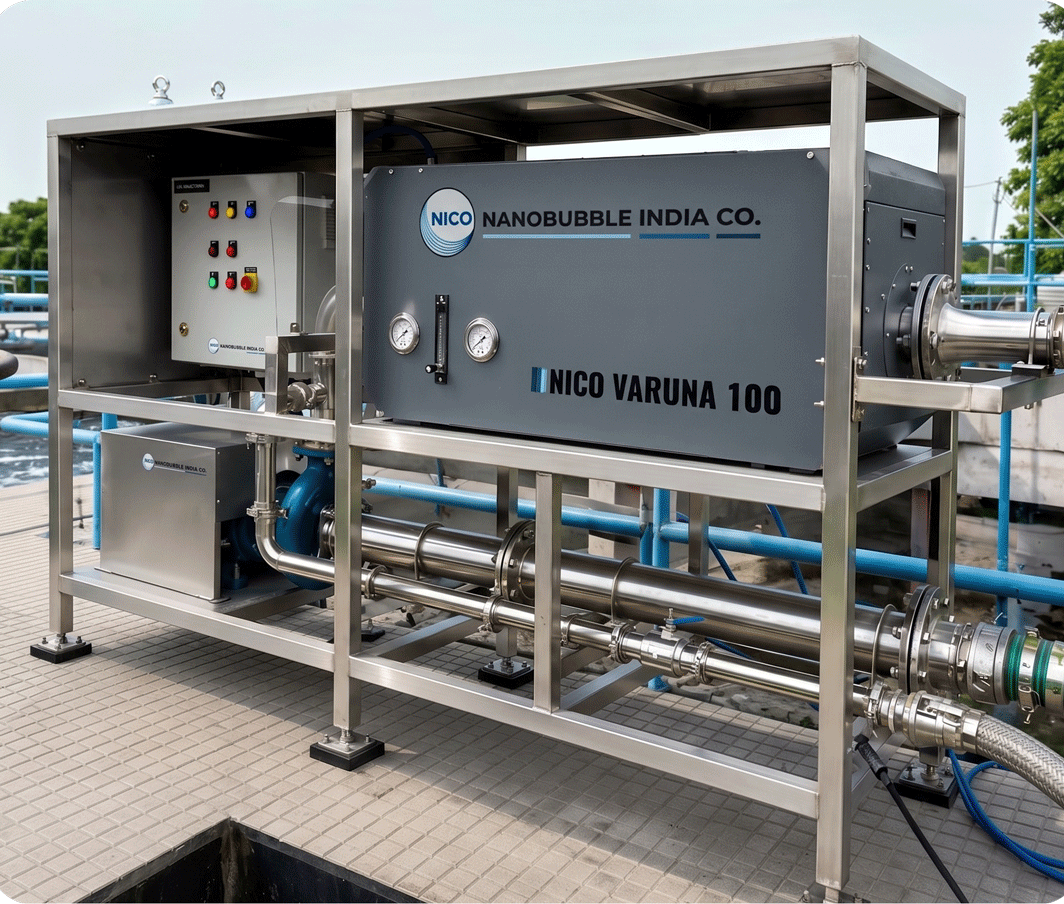
The nanobubble system was incorporated as a supplementary oxygenation solution within the existing aeration process. It operated in coordination with the plant's conventional blowers, allowing their operating load to be reduced while maintaining the required aerobic conditions.
Prior to nanobubble integration, the plant exhibited common limitations associated with conventional aeration, including high aeration energy consumption, limited oxygen-transfer efficiency, uneven dissolved oxygen distribution, and restricted treatment capacity within the existing biological infrastructure.
Maintaining stable aerobic conditions under increased hydraulic and organic loading also presented operational challenges, limiting the ability to increase plant throughput without additional infrastructure.
NICO deployed its VARUNA 100 Nanobubble Generator as a side-stream oxygenation system connected to the existing aeration tank. Water from the biological reactor was withdrawn, enriched with air nanobubbles, and returned through a circulation arrangement designed to improve oxygen distribution across the treatment zone.
The system was integrated with the existing blower infrastructure, allowing blower operating load to be reduced while supporting stable aerobic conditions.
| Performance Indicator | Unit | Before Nanobubble Integration | After Nanobubble Integration | |
|---|---|---|---|---|
| Plant Capacity | MLD | 7 | 9 | |
| Capacity Increase | % | - | 30 | |
| Aeration Energy Reduction | % | - | 30 | |
| Blower Power Demand | kW | 40 | 18 | |
| Combined Power Consumption | kW | Baseline | 25 | |
| Dissolved Oxygen (DO) | mg/L | 2-3 | 5-6 | |
| COD (Treated Effluent) | mg/L | 100 | 49 | |
| Oxygen Distribution | - | Localized variation | More uniform and stable | |
| Biological Operation | - | Conventional loading | Intensified and stabilized |
The system achieved stable oxygenation while reducing the operating requirement of the conventional blower system. The higher and more uniform DO profile allowed the biological reactors to process additional wastewater while maintaining treatment performance.
The plant capacity increased from 7 MLD to 9 MLD, enabling higher wastewater throughput using the existing treatment infrastructure without major civil expansion.
Integration of NICO Nanobubble Technology reduced the overall aeration-related energy demand while maintaining stable biological treatment conditions.
DO levels increased from approximately 2-3 mg/L to 5-6 mg/L, supporting a more stable and uniform aerobic environment.
The capacity enhancement enabled the plant to manage higher wastewater loading using its existing treatment infrastructure, reducing or deferring the need for additional aeration tanks, major civil construction, high-capacity blowers, or plant-footprint expansion.
The reduction in aeration energy also generated significant operational savings. The blower power requirement was reduced by approximately 45-50%, while the combined nanobubble and blower system maintained the required oxygenation conditions.
The improved and more stable dissolved oxygen environment supported aerobic biological processes, helping maintain treatment performance under increased loading conditions and reducing the risk of localized oxygen-deficient zones.
The reduction in aeration energy delivered indicative operational savings of approximately:
| Economic Indicator | Benefit | |||
|---|---|---|---|---|
| Monthly Electricity Saving | ₹0.8-1.0 lakh | |||
| Annual Electricity Saving | ₹10-12 lakh | |||
| Additional Treatment Capacity | 30% | |||
| Civil Expansion | Avoided or deferred | |||
| Operational Benefit | Lower blower loading and improved process stability |
The full-scale implementation demonstrates that NICO Nanobubble Technology can address two major constraints in wastewater treatment: high aeration energy demand and limited plant capacity.
By enhancing oxygen transfer and stabilizing biological treatment conditions, the system enabled higher wastewater throughput while reducing dependence on conventional blower operation. The project increased the effective treatment capacity of the 7 MLD STP by approximately 30% while delivering approximately 30% reduction in aeration-related energy consumption.
The results demonstrate a practical and scalable approach for modernizing existing municipal STPs, improving treatment performance and energy efficiency while unlocking additional capacity without capital-intensive civil expansion.