Enhancing Aquaculture Productivity and Water Quality
NICO Nanobubbles, a cutting-edge innovation, are driving a paradigm shift in aquaculture. Their infinitesimal size provides remarkable stability, allowing them to remain suspended in water for significantly longer durations. Nanobubbles for Aquaculture and Nanobubbles for Fish Farming are set to transform the industry by improving oxygen availability, reducing stress, supporting nutritional health, and promoting more sustainable and environmentally friendly farming practices.
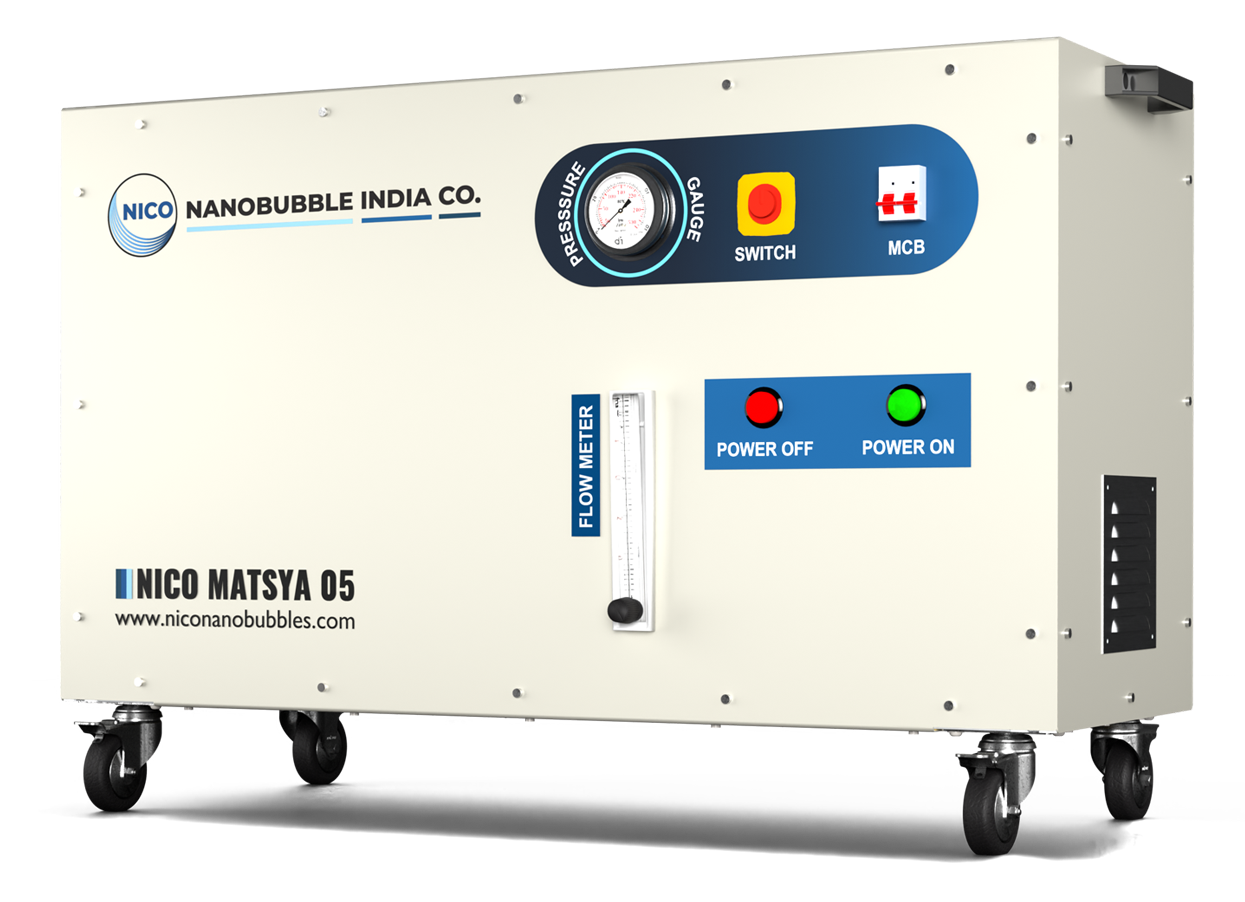
NICO MATSYA: Advanced Nanobubble Technology for Aquaculture
NICO MATSYA is an advanced nanobubble generator system designed for fish farming, shrimp cultivation, and commercial aquaculture operations. Engineered to enhance gas transfer and dissolved oxygen management, MATSYA helps aquaculture operators improve oxygen availability across ponds, tanks, and water circulation systems. Its application-specific configurations support a wide range of farming environments, from small-scale fish farms to large commercial aquaculture facilities. From freshwater and marine aquaculture to hatcheries, recirculating aquaculture systems (RAS), and biofloc farming, NICO MATSYA offers adaptable solutions for different water flow rates and operational requirements. The system can be integrated into suitable existing water circulation infrastructure, helping farmers incorporate nanobubble technology into their aquaculture water-management practices.
Challenges in Aquaculture
- Access to land and water & overstocking
- Lack of dissolved oxygen & sedimentation
- Poor water quality & disease outbreaks
- Organic matter accumulation
- Pathogen and parasite control
- Product quality
Benefits of Nanobubbles in Aquaculture
- Increase the Dissolved Oxygen Level: Nanobubble oxygenation systems for aquaculture enhance oxygen transfer efficiency by remaining suspended in water for extended periods due to their ultrafine size. Field implementations in fish and shrimp culture systems have demonstrated dissolved oxygen (DO) levels of 14–15 mg/L, compared with 5–6 mg/L in conventional systems, alongside improved oxygen retention and system stability. Actual DO levels depend on water temperature, salinity, gas supply, system configuration, and operating conditions.
- Waste Degradation: Introducing oxygen and ozone nanobubbles for aquaculture into the system forms reactive oxygen species (ROS), which oxidize organic matter and suspended particles, improving water quality. This nanobubbles aquaculture technology supports cleaner water conditions and more sustainable farming practices. Where appropriately designed ozone nanobubble treatment is applied, reported outcomes include 30–50% reductions in ammonia and chemical oxygen demand (COD) under suitable treatment conditions. Ozone dosing and residual concentrations must be carefully controlled to protect fish and shrimp.
- Pathogen Control: Aquaculture water treatment with nanobubbles effectively oxidizes harmful bacterial, fungal, and viral organisms, eradicating pathogens and preventing disease outbreaks. This advanced method eliminates the need for draining or disinfecting water, offering a safer alternative.
- Probiotic and Nutrient Carriers: Nanobubble technology for fish farming enhances the uptake of probiotics and nutrients by encapsulating them. Probiotics also help break down complex compounds in feed and suppress harmful bacteria, boosting water quality.
- Enhanced Water Circulation: The natural buoyancy force of nanobubbles in aquaculture, coupled with their Brownian motion, promotes water circulation within ponds. This ensures even distribution of oxygen and nutrients, critical for fish and shrimp health.
- Sustainable Solution: As nanobubble technology in aquaculture comprises only gas and water, it offers minimal risk of introducing harmful chemicals or residues into aquatic ecosystems, ensuring a sustainable farming practice.
- Enhanced Growth Rate and Quality: By improving oxygen supply, nutrient uptake, eliminating pathogens, and reducing waste, the benefits of nanobubbles in fish farming include accelerated growth rates and superior product quality. Under suitable operating conditions, reported application outcomes include 20–40% increases in stocking density, 10–25% improvements in feed conversion ratio (FCR), and 15–30% higher growth rates in fish and shrimp. These outcomes depend on species, stocking density, feeding practices, baseline water quality, and farm management.
Oxygen Nanobubbles for Fish and Shrimp Farming
Dissolved oxygen is a critical parameter in aquaculture, influencing fish respiration, shrimp health, feeding activity, and overall production performance. Oxygen demand can fluctuate with stocking density, feeding rates, water temperature, and microbial activity. NICO MATSYA nanobubble generator systems are designed to support oxygen transfer and dissolved oxygen management, helping aquaculture operators maintain suitable water conditions for their cultured species. recirculation systems, farmers can complement conventional aeration and water-management practices. Improved oxygen availability can help reduce oxygen-related stress and support healthy aquatic environments. Performance depends on species requirements, system design, oxygen demand, and operating conditions.
Nanobubble Technology for RAS, Biofloc, and Intensive Aquaculture
NICO MATSYA can be considered for recirculating aquaculture systems (RAS), biofloc fish farming, shrimp hatcheries, nursery tanks, and intensive fish-cultivation systems. In RAS installations, oxygen management is important for cultured animals and the biological filtration processes that help convert ammonia and nitrite. In biofloc systems, adequate oxygen availability is particularly important because cultured animals and active microbial communities contribute to overall oxygen demand. For shrimp farming and hatchery operations, MATSYA offers an approach to oxygenation that can be evaluated according to tank or pond volume, water circulation rate, stocking density, and species-specific requirements. In high-density aquaculture, appropriate oxygen management should be combined with effective filtration, solids removal, monitoring, and responsible stocking practices.
Improving Aquaculture Water Quality and Feed Utilization
Water quality management plays an important role in feed conversion, growth, and survival in fish and shrimp farming. Insufficient oxygen, excessive organic loading, and unstable water parameters can affect feeding activity and aquatic health. NICO MATSYA supports oxygen transfer and distribution as part of an integrated water-management strategy, helping operators maintain suitable conditions for aquatic animals and beneficial biological processes. By combining nanobubble oxygenation with appropriate feeding schedules, filtration, waste removal, and routine water-quality monitoring, aquaculture operators can work toward improved production efficiency and more consistent growing conditions.
In recirculating aquaculture systems (RAS), reported application outcomes include 15–25% reductions in mortality rates and 20–35% lower energy consumption, depending on system configuration, baseline conditions, and the extent to which conventional aeration can be optimized. Improved oxygen availability, combined with appropriate water-quality management, can help support aquatic health and more efficient farm operations.
Advanced Aquaculture with Nanobubbles
Embrace the future of aquaculture with oxygenation systems for fish and shrimp farming. NICO Nanobubble systems deliver unparalleled efficiency in water quality improvement, waste degradation, pathogen control, and enhanced growth. The benefits of nanobubbles in farming ensure a sustainable and thriving aquaculture operation that meets modern challenges while boosting productivity.
NICO MATSYA nanobubble generator systems are designed for a range of aquaculture flow requirements, with system capacities of up to 1,000 m³/h depending on the selected configuration. The appropriate system can be evaluated based on pond or tank volume, required circulation rate, oxygen demand, available infrastructure, and water-quality conditions. This allows aquaculture operators to explore application-specific solutions for fish farms, shrimp cultivation, hatcheries, RAS, and large-scale commercial installations. Discover the NICO MATSYA Nanobubble Generator System to explore its applications in oxygenation, aquatic health, and aquaculture water management. Contact NICO to discuss your farm's water flow, dissolved oxygen requirements, and suitable system configuration.